Energy, Critical Minerals and Global Power Projection
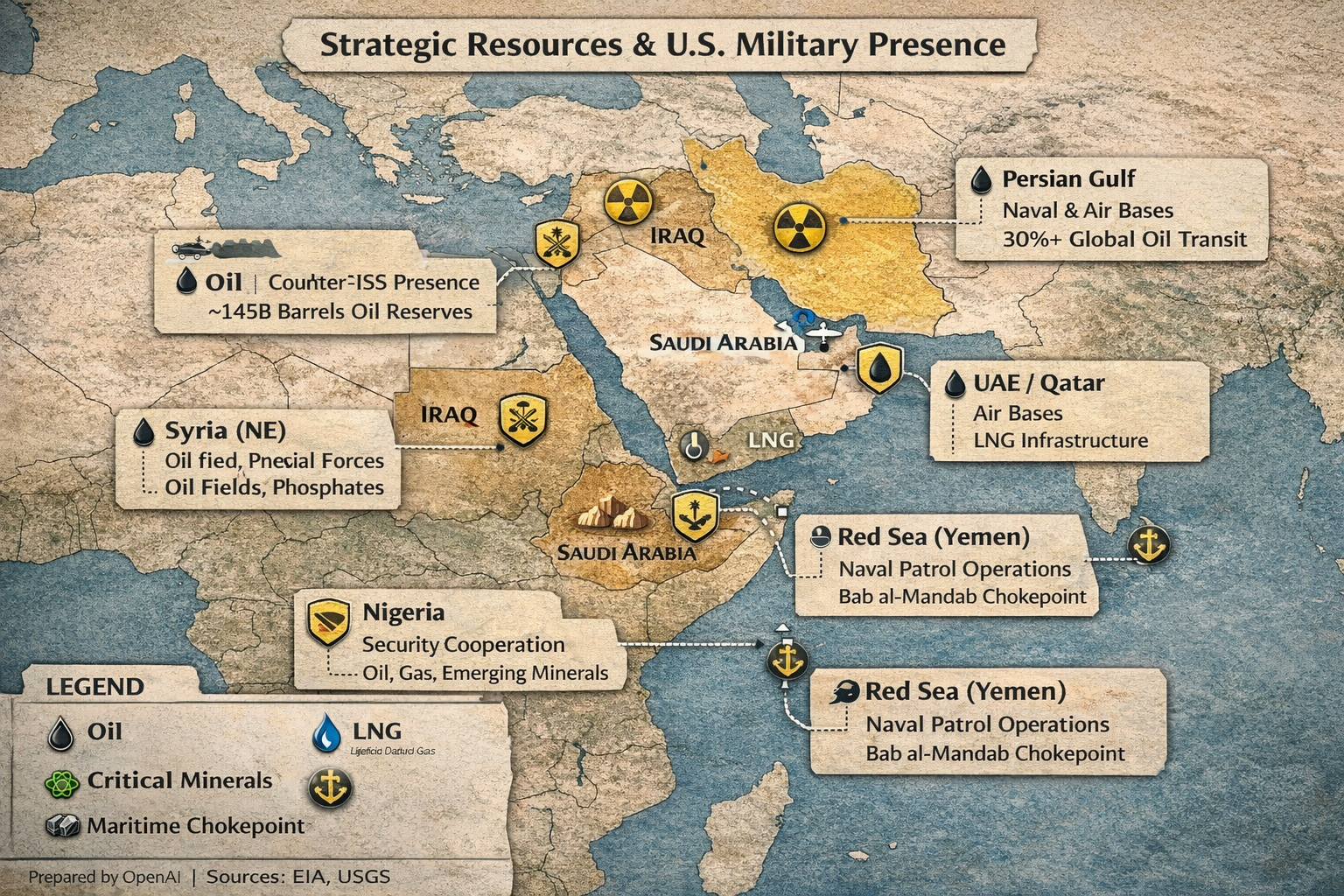
The global military footprint of the United States spans multiple regions where strategic resources, energy infrastructure, and trade corridors converge. While official justifications for military presence often center on counterterrorism, alliance commitments, or regional stability, a structural geopolitical pattern becomes visible when mapping military engagement against:
- Proven oil and gas reserves
- Critical mineral deposits
- Maritime chokepoints
- Industrial supply chains
This overlap does not prove intent. However, it reveals a consistent alignment between geopolitical friction zones and high-value economic assets.
1. The Persian Gulf – Energy Artery of the Planet
Roughly one-third of global seaborne oil passes through the Strait of Hormuz.
Countries in this region collectively hold:
- Over 50% of proven global oil reserves
- Massive natural gas deposits (Qatar and Iran share the world’s largest gas field)
The U.S. Fifth Fleet (Bahrain) and major air bases in Qatar and the UAE provide leverage over:
- Energy market stability
- Maritime insurance rates
- Regional deterrence
Control here equals influence over global energy pricing.
2. Iraq – Energy Infrastructure and Regional Balance
Iraq holds approximately 145 billion barrels of proven oil reserves, making it one of the top five globally.
Although the official mission centers on counter-ISIS operations, the strategic significance includes:
- Protection of energy infrastructure
- Influence over oil market output
- Buffer positioning between Iran and Gulf allies
Energy infrastructure security is inseparable from regional military presence.
3. Northeastern Syria – Limited Forces, Strategic Terrain
U.S. special forces remain in northeastern Syria primarily under anti-ISIS mandates.
However, the area contains:
- Key oil fields (Al-Hasakah region)
- Major phosphate reserves
- Land corridors linking Iran to the Mediterranean
Small troop numbers can hold disproportionate strategic weight when positioned over resource nodes.
4. Red Sea & Bab al-Mandab – Maritime Chokepoint
The Bab al-Mandab Strait connects:
- The Red Sea
- The Suez Canal
- The Indian Ocean
Nearly 10% of global trade passes through this corridor.
Instability in Yemen affects:
- European energy imports
- Asian shipping lanes
- Global freight insurance costs
Naval presence here is about securing trade continuity.
5. Nigeria & West Africa – Oil and Emerging Mineral Potential
Nigeria is Africa’s largest oil producer.
West Africa more broadly contains:
- Offshore deep-water oil reserves
- Lithium prospects
- Cobalt deposits
- Rare earth potential
As battery supply chains become strategic assets in global competition (EVs, defense systems, renewable infrastructure), mineral security becomes as critical as oil once was.
6. Critical Minerals – The New Strategic Layer
Modern military and industrial power depends on:
- Rare earth elements (missile guidance systems, radar)
- Cobalt (batteries, aerospace alloys)
- Titanium (aircraft, naval systems)
- Uranium (nuclear fuel cycle)
Regions with political instability and mineral wealth naturally attract great power competition.
This is not uniquely American behavior. China, Russia, and EU states actively pursue similar mineral access strategies worldwide.
Structural Pattern: Three Overlapping Drivers
When mapping military presence against economic geography, three recurring drivers emerge:
1. Energy Flow Protection
Oil and LNG still underpin global macroeconomic stability.
2. Supply Chain Security
Critical minerals determine technological superiority.
3. Maritime Corridor Control
Chokepoints influence global trade leverage.
These are structural drivers of power politics.
When military deployments are placed alongside maps of energy reserves, mineral deposits, and maritime corridors, a structural reality becomes difficult to ignore:
geography and resources continue to shape global power politics.
This does not imply that every intervention is designed solely to control oil fields or mining regions. Modern conflicts are complex. They involve terrorism, alliances, domestic politics, deterrence strategy, and regional rivalries.
However, a recurring pattern emerges:
-
Major energy corridors coincide with naval presence.
-
Oil-rich regions coincide with long-term stabilization missions.
-
Critical mineral zones increasingly overlap with strategic competition.
-
Maritime chokepoints attract sustained military patrols.
This alignment is not accidental — it reflects how modern states protect economic continuity.
In the 21st century, power is defined less by territorial conquest and more by:
-
Securing energy flow
-
Stabilizing supply chains
-
Protecting transport infrastructure
-
Maintaining access to strategic materials
Oil still matters.
Gas still matters.
But so do cobalt, rare earth elements, titanium, and phosphate.
Industrial resilience, defense manufacturing, and technological leadership depend on them.
The United States is not alone in this logic. China invests heavily in African mining infrastructure. Russia leverages energy exports for geopolitical influence. The European Union secures maritime corridors and critical raw material partnerships.
This is not a story about conspiracy.
It is a story about structural competition.
When great powers operate abroad, they operate where:
-
Supply chains are vulnerable
-
Markets can be disrupted
-
Strategic leverage can be gained
Seen through this lens, military presence becomes part of a broader economic architecture.
Understanding this framework does not simplify global politics —
it clarifies it.