For the first time in more than half a century, humans are preparing to leave Earth’s orbit and travel toward the Moon again. The Artemis II mission, led by NASA, represents a turning point in modern space exploration. Unlike the legendary Apollo Program, which ended in 1972, Artemis is not just about planting flags and leaving footprints. This time, the goal is to build a long-term human presence beyond Earth.
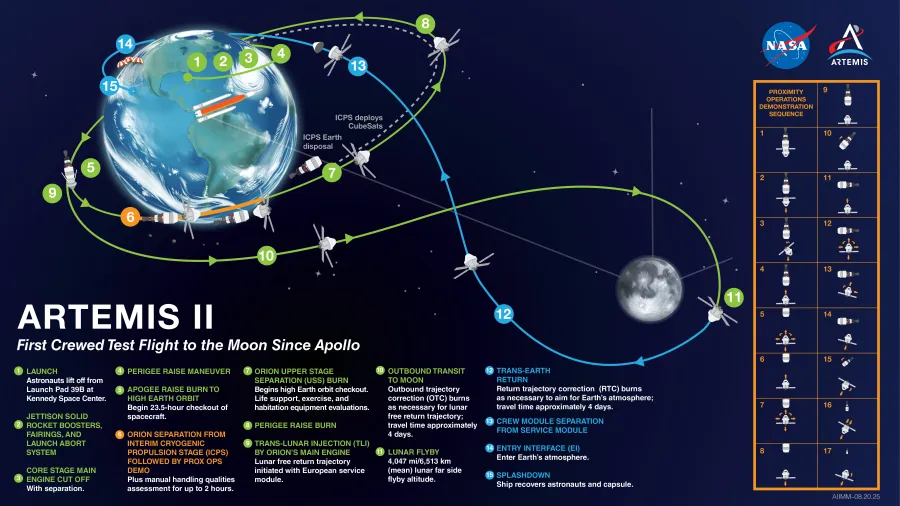
Scheduled for no earlier than 2026, Artemis II will be the first crewed mission in the Artemis program. It will send four astronauts aboard the Orion spacecraft, launched by the powerful Space Launch System. The mission will not land on the Moon, which might sound disappointing if you expected fireworks, but that is entirely intentional. Artemis II is designed as a critical test flight, ensuring that every system works properly before humans attempt a lunar landing in the next phase.
The crew itself reflects a new era of space exploration. Commanded by Reid Wiseman, the mission also includes pilot Victor Glover, mission specialist Christina Koch, and Canadian astronaut Jeremy Hansen. This will be the first time a Canadian astronaut travels to the Moon’s vicinity, and notably, the mission includes both the first woman and the first person of color ever assigned to a lunar mission. It took humanity long enough, but better late than never.
During the mission, Orion will travel thousands of kilometers beyond the Moon, following a trajectory known as a free-return path. This means that, even if systems fail, the spacecraft will naturally loop around the Moon and return to Earth using gravitational forces. It is the kind of backup plan you want when you are flying through space at extreme speeds with absolutely no room for error.
The mission is expected to last around 10 days. During that time, astronauts will test life-support systems, navigation, communication, and manual control of the spacecraft. Unlike previous uncrewed tests, Artemis II will finally answer the question engineers actually care about: does all of this still work when humans are inside, breathing, moving, and inevitably pressing things they probably should not?
One of the most critical challenges is re-entry. Returning from lunar distances means hitting Earth’s atmosphere at speeds exceeding 40,000 km/h. The heat shield on Orion must withstand temperatures approaching 2,800 degrees Celsius. If that fails, the mission does not end with a debrief. It ends in a way nobody wants to talk about.
Artemis II is not just a standalone mission. It is a stepping stone toward Artemis III, which aims to land humans on the Moon’s surface for the first time since Apollo 17. Beyond that, the Artemis program is intended to establish a sustainable human presence on the Moon, including the planned Lunar Gateway space station and surface habitats. The long-term objective is even more ambitious: using the Moon as a training ground for future missions to Mars.
This mission also reflects a shift in how space exploration is conducted. Unlike Apollo, Artemis involves international partnerships and private companies. Agencies such as the Canadian Space Agency and European partners contribute technology and expertise, while commercial players support infrastructure and logistics. Space is no longer just a government playground. It is becoming an ecosystem.
Artemis II matters because it bridges the past and the future. It reconnects humanity with deep space exploration while testing the technologies and strategies needed for long-term survival beyond Earth. After decades of orbiting our own planet, this mission finally pushes the boundary outward again.
And despite all the advancements in technology, artificial intelligence, and engineering, one thing remains unchanged. Sending humans into space is still a calculated risk. It always has been. The difference now is that we are not just trying to visit the Moon.
We are trying to stay.