For the first time in more than half a century, humans are once again traveling beyond low Earth orbit and heading toward the Moon. NASA’s Artemis II mission marks a defining moment in modern space exploration, signaling not just a return, but the beginning of a sustained effort to push human presence deeper into space.
Launched at 6:35 p.m. EDT on April 1, 2026, from Kennedy Space Center in Florida, the mission carries four astronauts aboard the Orion spacecraft: Reid Wiseman, Victor Glover, Christina Koch, and Jeremy Hansen. Together, they represent not only NASA, but also international cooperation in a mission that is as symbolic as it is technical.
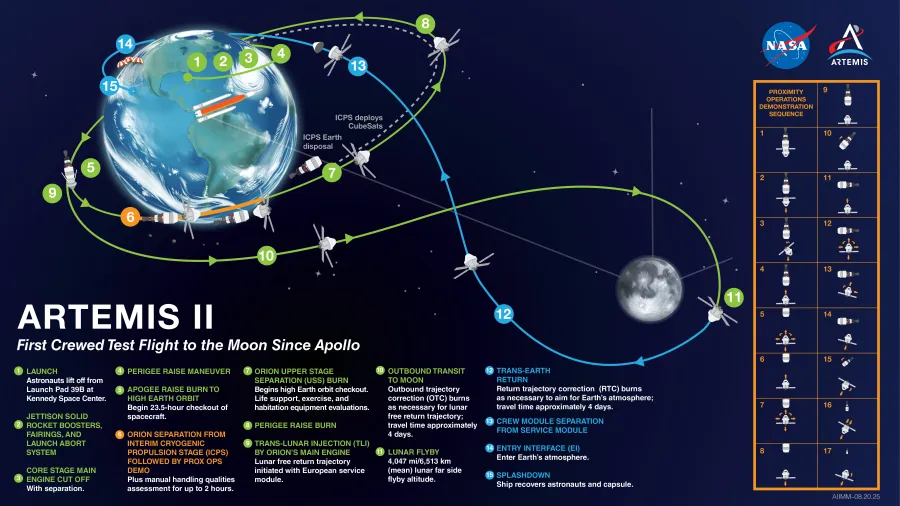
Unlike the historic Apollo program missions, Artemis II is not attempting a landing. Instead, it serves as a critical test flight, designed to evaluate how the Orion spacecraft and its systems perform in the harsh and unforgiving environment of deep space. Every aspect of the mission is under scrutiny, from life-support systems and propulsion to navigation, communication, and crew operations.
Over the course of approximately ten days, the crew will travel a total distance of around 695,000 miles. At its peak, Orion will reach roughly 252,760 miles from Earth, surpassing the record set by Apollo 13 in 1970. That milestone alone marks Artemis II as the farthest any human has ever traveled from Earth, a reminder that even in an era of advanced robotics, human exploration still pushes boundaries in ways machines alone cannot.
The most critical phase of the mission occurred during the lunar flyby on April 6. As Orion passed behind the Moon, communication with Earth was temporarily lost, a planned but still dramatic reminder of the isolation of deep space travel. During this period, the astronauts observed both the near and far sides of the Moon, capturing imagery and conducting scientific observations. At its closest approach, the spacecraft came within approximately 4,070 miles of the lunar surface.
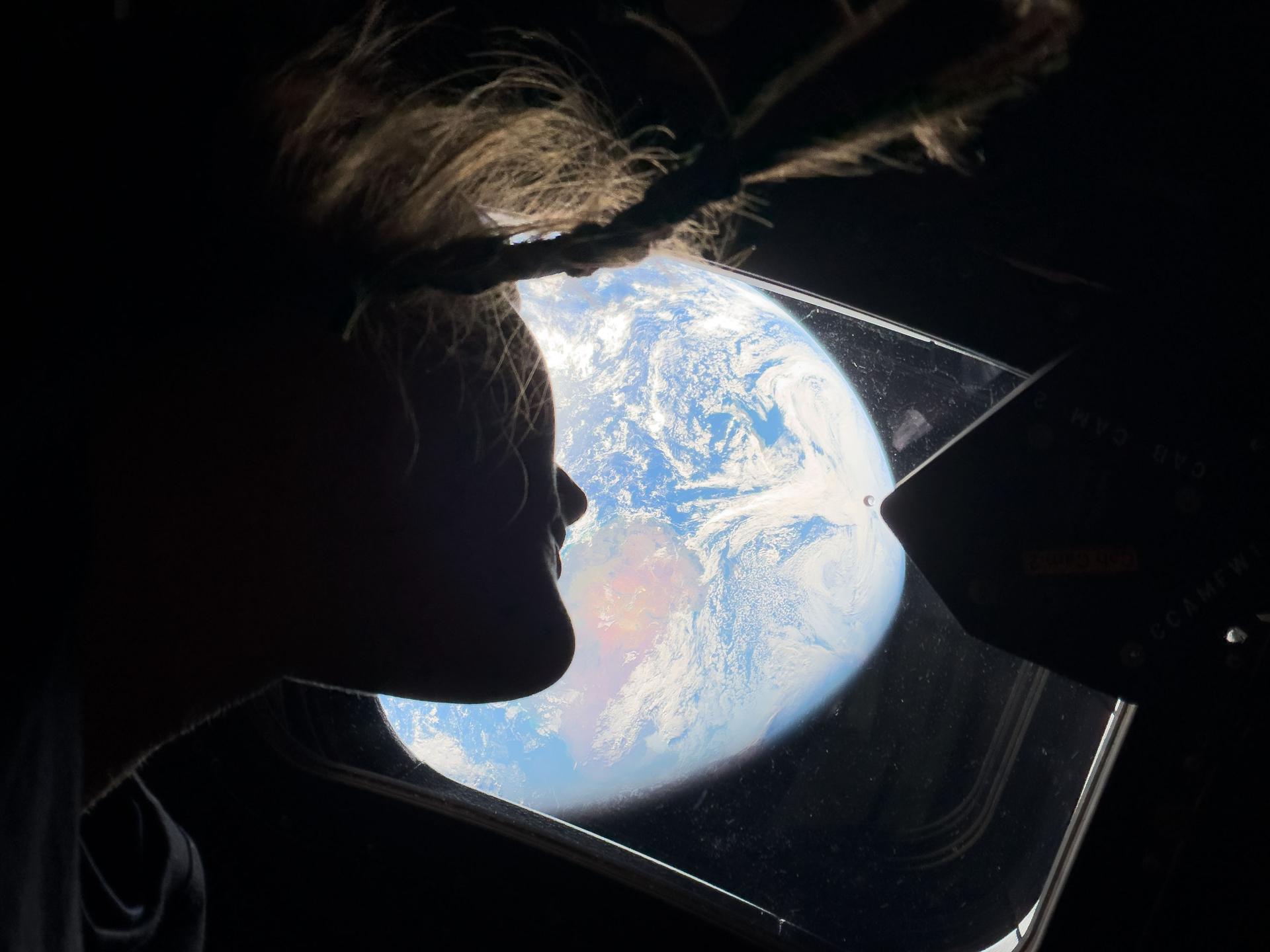
From that distance, the Moon appears surprisingly modest in size, roughly comparable to a basketball held at arm’s length. Yet what the crew sees is far from ordinary. Human observation, even now, remains uniquely valuable. The ability to detect subtle variations in texture, color, and surface features can lead to insights that automated systems might overlook. Artemis II is as much about human perception as it is about hardware.
Life aboard Orion reflects decades of progress since early spaceflight. The crew has access to nearly 200 food items, including familiar meals and beverages such as coffee, tortillas, and prepared dishes designed to maintain both physical health and morale. While the setting is extraordinary, the goal is to make the experience as stable and sustainable as possible, a necessity for future long-duration missions.
If all proceeds as planned, Artemis II will conclude with a splashdown off the coast of San Diego on April 10 at approximately 8:07 p.m. EDT. Recovery teams will retrieve the crew and transport them to the USS John P. Murtha, where they will undergo initial medical evaluations before returning to Houston.
The significance of Artemis II extends far beyond this single mission. It is a proving ground for the systems and strategies that will enable future operations, including Artemis III, which aims to return humans to the lunar surface. More broadly, it represents a step toward establishing a long-term human presence on the Moon and, eventually, missions to Mars.
In many ways, Artemis II is a quiet test, one that lacks the immediate spectacle of a landing. But its importance cannot be overstated. It is the moment where theory meets reality, where systems are tested not in simulations, but in the vast emptiness of space. And if it succeeds, it will confirm something both simple and profound: that humanity is ready to go farther than it ever has before, and this time, perhaps, to stay.